Three acronyms now shape how people find you online, and mixing them up leads to wasted effort. SEO, AEO, and GEO overlap, but each targets a different way that users get answers. Understanding the difference helps you invest where it actually moves the needle.
SEO: search engine optimization
SEO is the familiar discipline of ranking in traditional search results. The goal is to appear in the list of links for a query and earn the click. It rests on relevant content, a healthy technical foundation, and authority earned through links and reputation. SEO remains the base layer, because both answer engines and generative systems still draw heavily on the pages that already rank well.
AEO: answer engine optimization
AEO focuses on being the direct answer to a question, whether in a featured snippet, a voice assistant response, or a concise answer box. Instead of only competing for a position in a list, you compete to be the single response the engine reads back.
- Answer questions directly in one or two clear sentences near a relevant heading.
- Structure content for extraction with question style headings, lists, and tables.
- Add relevant structured data so engines understand the format of your answer.
- Target the real questions people ask, including natural, conversational phrasing.
GEO: generative engine optimization
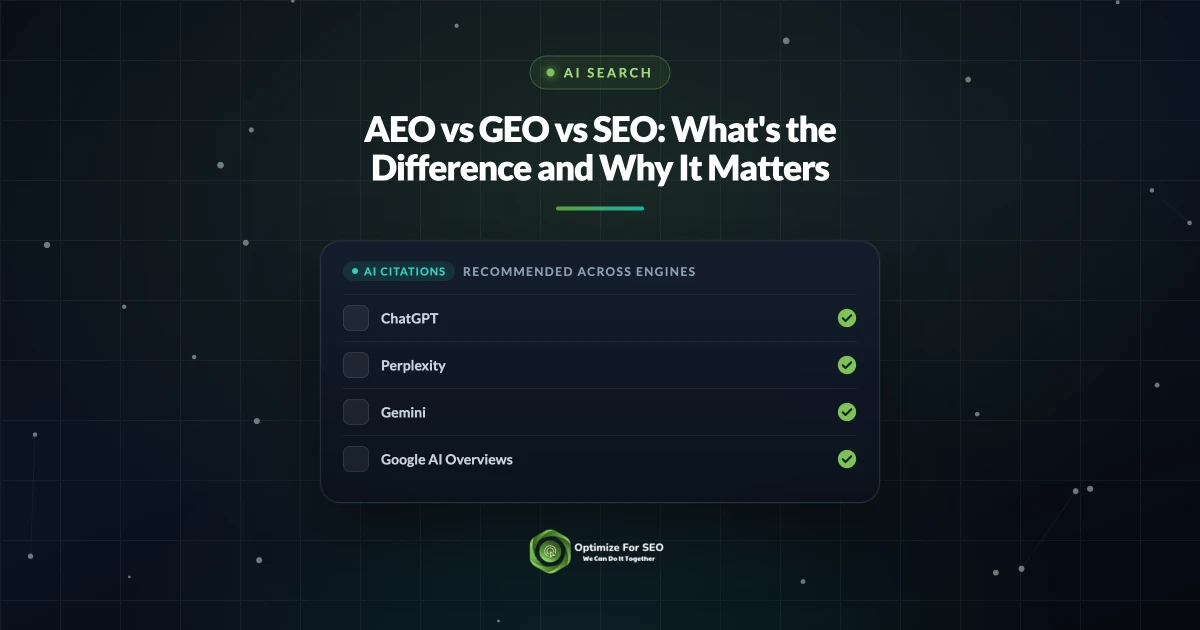
GEO is the newest of the three. It aims to get your brand mentioned and cited inside AI generated answers from systems like ChatGPT, Google AI Overviews, and similar assistants. These systems synthesize a response from many sources, so the goal is to be one of the sources they trust and quote.
- Publish clear, factual content that a language model can summarize accurately.
- Build topical depth so the model associates your brand with the subject.
- Earn mentions across reputable sites, since generative systems favor sources with a credible footprint.
- Keep information current and consistent, because contradictions reduce how often you get cited.
How the three fit together
These are not competing strategies you must choose between. They are layers built on a shared foundation. Strong SEO earns the rankings that answer engines and generative systems pull from. AEO shapes your content so it can be lifted as a direct answer. GEO extends that visibility into AI generated responses. A page that is genuinely well optimized often performs across all three at once, because clarity, structure, and trust benefit every channel.
The practical takeaway is to stop treating AI search as a separate project. Build content that answers real questions clearly, back it with technical health and authority, and you position yourself to win in classic search and AI answers alike. Our SEO services approach these as one connected strategy rather than three disconnected tactics.
Where to focus first
If you are early in this shift, get the fundamentals right before chasing the newest acronym. Fix technical issues, publish clear and comprehensive content, and earn genuine authority. Then layer in answer focused formatting and track whether your brand shows up in AI answers. If you also run paid campaigns, aligning them with your organic strategy through our ChatGPT ads service keeps your presence consistent across every surface where buyers now search.
Want a strategy that covers all three?
Winning across search and AI answers takes a plan that treats SEO, AEO, and GEO as one system. If you want a roadmap tailored to your business and market, our SEO services team can build it with you. Reach out and we will map your next steps.
Want this handled for you? Our AI SEO services can help you rank on Google and get cited by ChatGPT, Gemini, Claude and Perplexity.
Aashirvad Kumar
Writes about SEO, digital marketing and growth at Optimize For SEO.