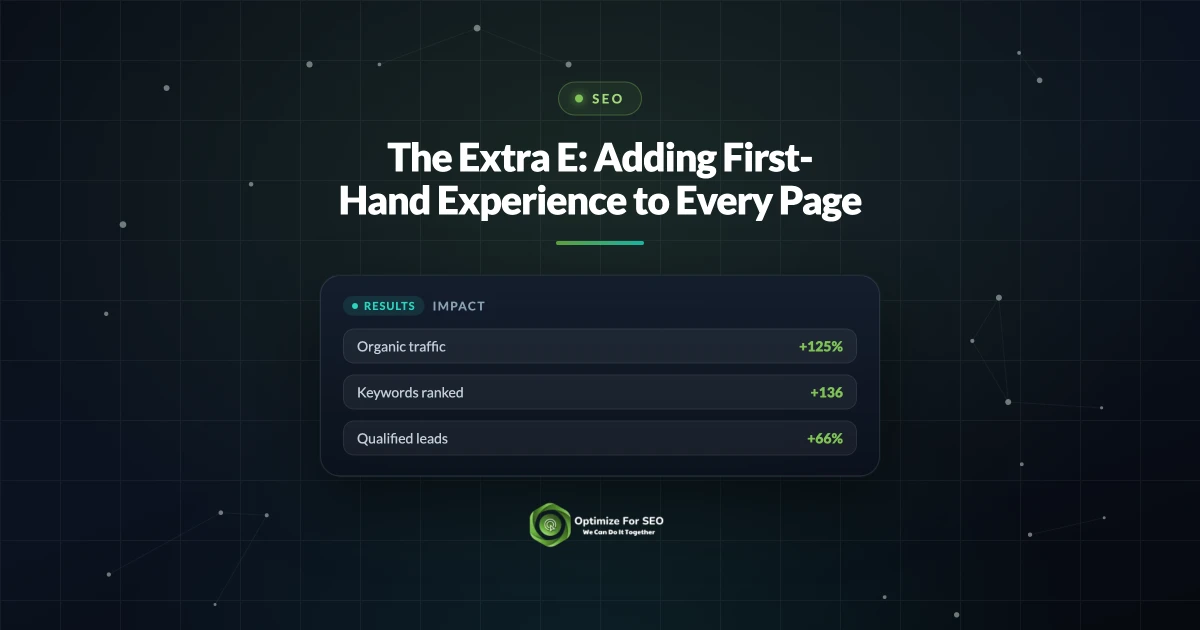
Any capable language model can now draft a fluent, technically correct article on almost any subject in seconds. That is exactly why competent writing has stopped being a competitive advantage. When everyone can generate a clean, accurate explainer on demand, the thing that separates one page from a thousand near-identical ones is the single input a model cannot manufacture: proof that a real person actually did the thing. Google gave that signal a name in late 2022 when it added an extra E for Experience to its E-A-T framework, turning it into E-E-A-T.
Experience is now the differentiator. Expertise, authority, and trust still matter, but they are easier for polished AI text to imitate. First-hand experience is different. It leaves fingerprints a model has no way to invent: original test results, photos you took, numbers only you have, named people who did the work. This post covers what Experience means in Google's guidelines, why it became the anti-commodity signal after 2026's core updates, and how to add it systematically to every page.
Key Takeaways
- Experience is the one part of E-E-A-T a machine cannot fake: first-hand proof you used the product, visited the place, or ran the test.
- Google's Search Quality Rater Guidelines now tell raters to give the lowest rating to mass-produced pages with little effort, originality, or added value, whoever wrote them.
- Real Experience shows up as original data, photos you shot, specific numbers, case studies, and named practitioners, not adjectives.
- Experience feeds Trust, the member of E-E-A-T that Google calls most important, so build it into every page type deliberately.
- After the 2026 core updates rewarded people-first content, Experience is what separates a real business from a content farm.
What "Experience" Actually Means in Google's E-E-A-T
When Google added the second E, it defined Experience as the extent to which a content creator has first-hand or life experience with the topic. The examples it gives are deliberately concrete: someone who has actually used a product, visited a place, or done the thing being described. That is distinct from Expertise, which is about formal knowledge and credentials. For many everyday queries, the experienced voice is the one searchers trust.
Google's own guidance on creating helpful, people-first content makes this a direct self-assessment question. It asks whether your content clearly demonstrates "first-hand expertise and a depth of knowledge", for example the kind that comes from having actually used a product or visited a place. Notice that Trust sits at the center of the framework: Google calls it the most important member of the family, and Experience is one of the signals that earns it.
Why Experience Became the Anti-Commodity Signal
The stakes rose sharply in the last two years. Google updated its publicly available Search Quality Rater Guidelines to instruct raters to assign the lowest rating to pages whose main content is copied, paraphrased, or auto-generated with little to no effort, originality, and added value. The trigger is not "AI wrote this." It is the combination of scale plus no effort plus no originality: competent prose produced at volume, human or machine, lands in the same low bucket.
The 2026 core updates leaned into the same principle. They rewarded freshness, topical authority, and people-first content, and signaled that volume alone no longer carries a site. When the open web fills with fluent, interchangeable articles, scarcity moves to whatever cannot be spun up on demand, and that scarce thing is genuine experience. It is also why experience pairs so well with real depth; building topical authority through content clusters gives your experience somewhere to live and compound instead of sitting in one orphaned post.
What First-Hand Experience Looks Like on a Page
Experience is not a tone you write in. It is evidence you attach. Strip the adjectives out of a page, and if nothing proves a person did the work, you have no Experience signal. Here is what actually reads as first-hand, to both a searcher and a model parsing the page:
- Original testing and real data. "We ran this on 12 client sites and saw a median 1.9 second improvement" beats "this dramatically improves speed."
- Photos and screenshots you captured. Your own product shots, dashboards, and setup photos, not stock imagery a competitor could also use.
- Specific numbers. Exact prices, dimensions, timings, sample sizes, and dates. Precision is hard to fake and easy to trust.
- Case studies with outcomes. A named situation, what you did, and the measurable result, including the parts that did not go perfectly.
- Named practitioners. A real author with a bio and credentials, quotes from the people who did the work, and a short note on how you know.
Every item answers the quiet question the reader and the algorithm are both asking: how do you know this? Generic content dodges it; experienced content answers it in the first screen.
How to Add Experience Systematically to Every Page Type
Treat this as a repeatable checklist. Each page type has its own highest-leverage move.
Product pages. Supplement stock imagery with photos you shot, add sizing and fit notes from actually handling the item, and surface genuine customer feedback prominently. Reviews are experience at scale from your buyers, and our guide on using reviews to boost trust and SEO covers how to display and mark them up so they count.
Service pages. This is where thin pages hurt most, because buyers are judging whether you have done this before. Add named case studies with real outcomes, show the practitioners who deliver the work, and describe your actual process rather than a generic promise. If you want a team to audit where your pages read as commodity and rebuild them around genuine proof, that is the core of our answer engine optimization services.
Blog and resource pages. Give every substantive post a real byline with a short bio, lead with data or a screenshot you produced, and include a "how we tested" or "what we found" section. One original chart does more for the page than five hundred words the model could have written itself.
Making Experience a Durable Ranking Advantage
Adding experience once is worth little if the signal is invisible to the systems reading your site, so make it machine-readable. Use author and Organization structured data so bylines and credentials are unambiguous, keep author bios consistent across pages, and ensure your claims match your Google Business Profile and other listings. A page that says one thing while its schema and directories say another undercuts the trust you are building.
These are foundations, not decorations, and they break easily during redesigns and migrations. Confirm that your author markup, canonical tags, and crawlable content stay intact; running through a technical SEO audit checklist for growing sites catches the issues that quietly strip your experience signals before a model ever sees them.
The pages that keep winning will prove a real business, with real people, actually did the work. Add original data, your own photos, named authors, and honest case studies to every template, make those signals machine-readable, and you become the source both searchers and AI answer engines trust. If you want a review of where your pages read as commodity and a plan to rebuild them around genuine experience, talk to our team and we will map every page that needs it.
Read More
- Using Reviews to Boost Both Trust and SEO
- Topical Authority: Building Content Clusters That Actually Rank
- The Technical SEO Audit Checklist for Growing Sites
- How to Rank in Google's AI Overviews in 2026
Frequently Asked Questions
What is the extra E in E-E-A-T?
The extra E stands for Experience. Google added it to the older E-A-T framework in December 2022, so the concept is now Experience, Expertise, Authoritativeness, and Trust. Experience measures how much first-hand or life experience the content creator has with the topic, such as having actually used a product or visited a place.
Can AI-generated content rank if it lacks first-hand experience?
Google says using AI is not automatically a problem, but its rater guidelines assign the lowest rating to content produced at scale with little effort, originality, or added value. Competent but interchangeable prose with no first-hand proof is exactly the profile those guidelines target, whether a human or a model wrote it.
How do I show first-hand experience on a service page?
Add named case studies with real, measurable outcomes, show the actual practitioners who deliver the work with short bios, and describe your real process instead of a generic promise. The goal is to answer the buyer's unspoken question, "have you done this before," with evidence rather than adjectives.
Do the Search Quality Rater Guidelines directly affect my rankings?
Not directly. Human raters do not set rankings for individual sites; they help Google evaluate whether its algorithm changes are moving quality in the right direction. But the guidelines describe what Google considers high and low quality, so building pages that raters would score well tends to align with what the ranking systems reward.
Which pages need Experience signals the most?
Service and product pages benefit most, because that is where buyers judge whether you have a real, first-hand track record. Generic blog posts are next, since mass-produced competitors are easiest to beat there with original data, photos, and named authorship. Start with the pages closest to a purchase decision.
Want this handled for you? Our SEO services agency can help you grow your organic traffic and revenue.
Aashirvad Kumar
Writes about SEO, digital marketing and growth at Optimize For SEO.