For most of the last decade, the reliable way to grow organic traffic was to publish more. More pages meant more keywords, more entry points, and more chances to rank for something. In 2026 that math broke. Google's core updates this year, rolling out in February, again in spring, and once more in May, kept sharpening the same message, and Google's own guidance on core updates now says it plainly: the systems reward content that is helpful, reliable, and people-first, and they judge your site as a whole. A pile of thin or redundant pages does not just fail to rank. It can drag down the pages that would have.
That is why content pruning has moved from a nice-to-have cleanup into a core ranking tactic. Pruning is the deliberate process of auditing every page you own, then deciding what to keep, improve, merge, redirect, or remove so the site as a whole reads as focused and authoritative. This post lays out a concrete process: how to inventory your pages, the metrics that decide each one's fate, a simple framework for the decision, how to merge overlapping pages with 301 redirects, and why cutting the weak pages lifts the strong ones.
Key Takeaways
- In 2026, sheer page volume no longer carries a site. Google's core updates weigh quality, E-E-A-T, and topical focus across the whole domain, so thin pages create drag.
- Content pruning is a structured audit: inventory every URL, score it on real metrics, then keep, improve, consolidate, redirect, or remove it.
- Judge pages on impressions, clicks, conversions, earned links, and crawl waste, not on word count or gut feel.
- Merge overlapping pages into one strong asset and 301 the losers, so you consolidate ranking signals instead of splitting them.
- Google calls deleting content a last resort. Most weak pages should be improved or consolidated, and only truly dead pages removed.
Why Page Volume Stopped Carrying Sites in 2026
The 2026 update cycle made the shift impossible to ignore. Core updates landed across the year, and Google reinforced that recovery comes from being helpful and people-first rather than from publishing volume. The May 2026 core update alone took about eleven days to fully roll out, according to Search Engine Land, and reshuffled winners and losers across large content sites. Then the spam updates hardened the floor. According to Search Engine Land's report on the August 2026 spam update, roughly 16.71% of URLs that had ranked in the top 10 fell beyond position 100 after it, an 82% jump versus a comparable period with no confirmed update, citing SE Ranking data. That update ran just two days and sixteen hours yet hit harder than usual.
Underneath these updates sits SpamBrain, Google's AI-based spam-prevention system, and a scoring model that increasingly reads quality as a site-wide signal. When a large share of your URLs are thin, outdated, or near-duplicates of each other, they dilute the topical clarity of everything around them and waste the crawl budget that should be spent on your best pages. Pruning is how you reverse that. You are not shrinking the site to look smaller. You are concentrating authority so the pages you keep can compete.
What Content Pruning and Consolidation Actually Mean
Pruning and consolidation are two moves in the same workflow. Pruning is the audit and the cut: identifying pages that no longer earn their place and deciding what happens to each. Consolidation is one of the outcomes: taking two or more overlapping pages that compete for the same intent and merging them into a single, more complete resource. Both aim at the same result, a tighter set of pages that each answer a clear question well.
Removal is the rarest outcome, not the default. Google is explicit that deleting content should be a last resort, reserved for pages you genuinely cannot salvage. Most weak pages are better improved or folded into a stronger one, because a page that still earns a few links or a trickle of qualified traffic carries signals worth keeping. The skill in pruning is telling those apart, and that is a job for data, not instinct.
Build the Inventory: Every URL, Every Metric
Start with a complete list of indexable URLs. Pull them from a crawl (Screaming Frog or Sitebulb), your XML sitemap, and Google Search Console's Pages report, then reconcile the three so nothing hides. Next to each URL, attach the numbers that actually predict value:
- Impressions and clicks: from Search Console, over the last 12 months. A page with impressions but no clicks has a relevance or title problem. A page with neither may be dead weight.
- Conversions and assisted conversions: from analytics. A low-traffic page that converts, or supports a converting journey, is a keeper regardless of raw volume.
- Backlinks and referring domains: a page with earned links has equity you must preserve through a redirect even if you retire the content.
- Internal links and topical role: whether the page supports a cluster or sits orphaned with no internal links pointing to it.
- Crawl waste and freshness: last-crawled date, last-updated date, and whether the page is a near-duplicate of another. Stale, redundant URLs are where crawl budget leaks.
Judge pages on this evidence, not on word count or how much you liked writing them. A thorough crawl and log review is also the moment to catch broken links, duplicate titles, and indexation errors, which is why we fold pruning into the same pass as our technical SEO audit checklist for sites.
The Five-Way Decision: Keep, Improve, Consolidate, Redirect, Remove
With the inventory scored, sort every URL into one of five buckets. This framework keeps the decision consistent across hundreds of pages.
- Keep: the page performs, converts, or holds strong links and clear intent. Leave it and protect it.
- Improve: the page targets a valuable query but underperforms. Rewrite it for depth, freshness, and first-hand expertise, and strengthen its internal links. This is where most of your effort should go.
- Consolidate: two or more pages compete for the same intent. Merge the best of each into one canonical page and redirect the rest.
- Redirect: the page is obsolete but sits on a URL with links or a close topical match. 301 it to the most relevant surviving page so the equity transfers.
- Remove: the page has no traffic, no links, no conversions, and no relevance, and cannot be salvaged. Let it return a 410 or 404. This is the smallest bucket.
The improve and consolidate buckets are where pruning creates topical authority rather than just tidiness. When you merge three shallow posts on one subject into a single definitive guide, you signal expertise on that topic, which is exactly the logic behind building topical authority with content clusters. Depth on fewer URLs beats breadth across many.
How to Merge Overlapping Pages With 301 Redirects
Consolidation only works if you preserve the signals the old pages earned. Follow a repeatable sequence. First, pick the winner, usually the URL with the most links, best rankings, or cleanest URL, and make it the canonical destination. Second, port over any unique value from the pages you are retiring: sections, examples, images, and the specific questions they answered, so the merged page is genuinely more complete, not just longer. Third, apply a 301 redirect from each retired URL to the winner, which passes the large majority of ranking signals and sends users to the right place.
Then handle the plumbing. Update internal links so they point directly at the surviving URL instead of hopping through a redirect, refresh the XML sitemap, and remove the retired URLs from it. Redirect to the most relevant page you can, never to the homepage, because an irrelevant redirect is often treated as a soft 404 and wastes the equity you were trying to save. Rebuilding those internal links cleanly is also a chance to speed up how the merged page gets recrawled, which we cover in our guide to an internal linking strategy for faster indexing. Finally, keep a redirect map so you can audit the moves later and spot any chains that need collapsing.
How Pruning Lifts the Pages You Keep
Cutting weak pages is not a defensive chore. It is one of the highest-leverage things you can do for the pages that remain. Three mechanisms drive the lift. Crawl efficiency improves, because search engines stop spending budget on low-value URLs and recrawl your important pages more often. Topical focus sharpens, because the site no longer sends mixed signals about what it is expert in. And link equity concentrates, because consolidation funnels the authority that was split across near-duplicates into one page strong enough to rank.
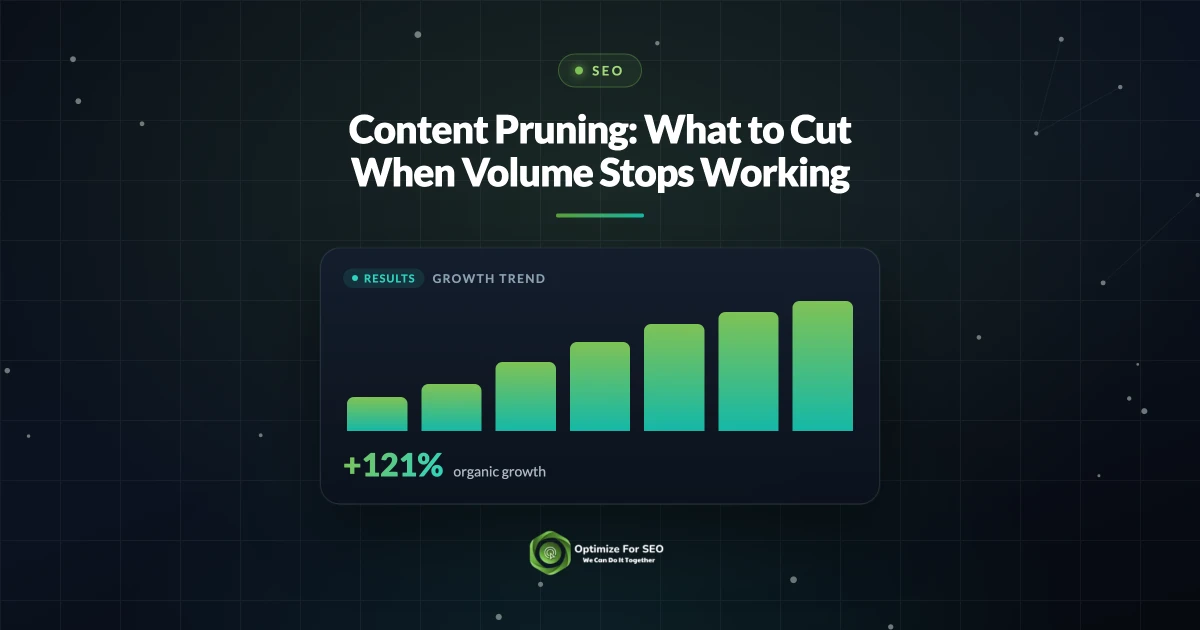
The pattern is common enough to plan around: after a well-executed prune, the surviving pages often gain impressions and positions even though you published nothing new. You did not add content. You removed the drag on it. That is the entire premise of pruning in 2026, and it is why quality-first sites recover from core updates while volume-first sites keep sliding.
Content pruning is not about deleting for its own sake. It is about making every page you keep pull its weight, so the whole domain reads as focused, current, and genuinely expert. Inventory honestly, judge on real metrics, improve or consolidate far more often than you remove, and preserve equity with clean 301s. If you would rather have a specialist run the audit, score every URL, and execute the consolidations without risking your traffic, our SEO and content strategy services are built for exactly that. To scope a pruning plan for your site, talk to our team and we will map the pages holding you back.
Read More
- The Technical SEO Audit Checklist for Growing Sites
- Topical Authority: Building Content Clusters That Actually Rank
- Internal Linking Strategy for Faster Indexing
- Google AI Mode Is Now the Default: What It Means for Your Website
Frequently Asked Questions
What is content pruning in SEO?
Content pruning is the structured process of auditing every page on your site and deciding what to do with each one: keep it, improve it, consolidate it with another page, redirect it, or remove it. The goal is a tighter, higher-quality set of pages so the whole domain reads as focused and authoritative to search engines.
Does deleting pages actually improve rankings?
It can, but removal should be rare. Google says deleting content is a last resort, only for pages that cannot be salvaged. The bigger gains usually come from improving underperforming pages and consolidating overlapping ones, which concentrates ranking signals and crawl budget on the pages worth keeping.
How do I decide which pages to prune?
Build an inventory of every URL and score each on impressions, clicks, conversions, backlinks, internal links, and freshness. Pages that earn traffic, conversions, or links are keepers. Pages with valuable target queries but weak performance should be improved. Overlapping pages should be merged, and only pages with no value at all should be removed.
What should I do when I merge two similar pages?
Pick the stronger URL as the destination, move any unique value from the other page into it so the result is more complete, then 301 redirect the retired URL to the survivor. Update internal links to point at the new URL directly and refresh your sitemap. This preserves the ranking signals both pages had earned.
Why does removing weak content help my other pages?
Weak pages waste crawl budget, blur what your site is expert in, and split link equity across near-duplicates. Pruning them lets search engines recrawl your important pages more often, sharpens your topical focus, and funnels authority into fewer, stronger pages, which often lifts the survivors even without new content.
How often should I run a content audit?
For most sites, a full content audit once or twice a year is enough, with a lighter review after any major Google core update. Fast-moving or large sites benefit from quarterly checks so thin and outdated pages do not accumulate and start dragging on the rest of the domain.
Want this handled for you? Our SEO services agency can help you grow your organic traffic and revenue.
Aashirvad Kumar
Writes about SEO, digital marketing and growth at Optimize For SEO.