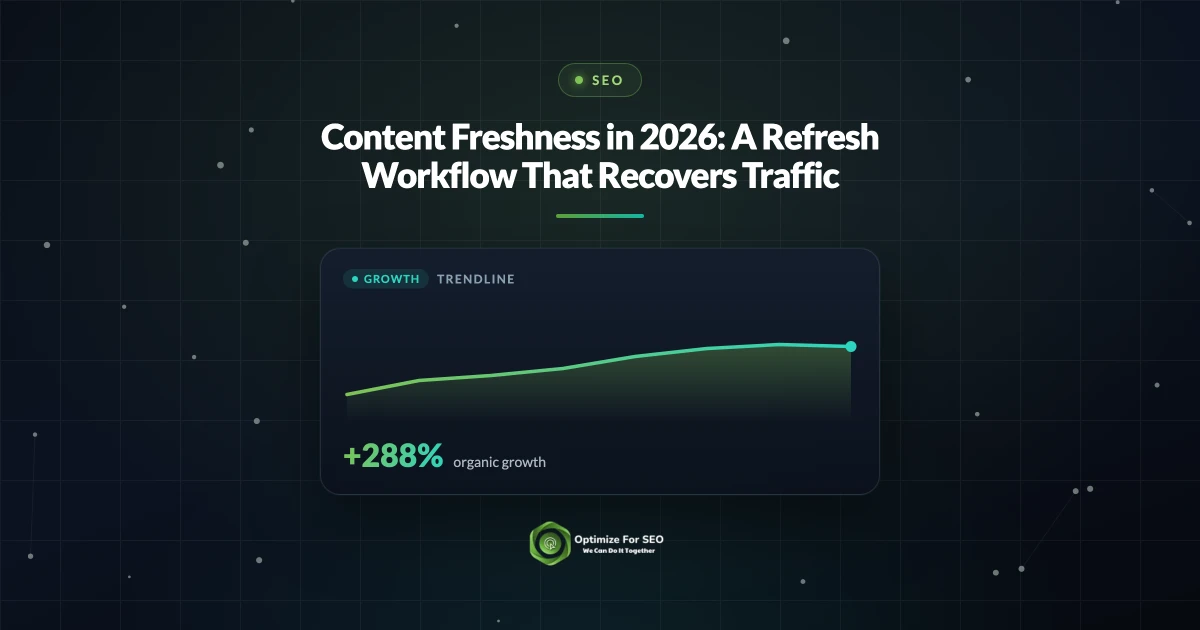
Rankings rarely fall off a cliff. They erode. A page that held steady for two years slips a position at a time as competitors publish something newer and its facts go stale. In 2026 that erosion is faster and less forgiving, because Google's core updates and AI-generated answers both reward content that is current and actively maintained. Google's own core updates guidance is blunt about the remedy: there is no switch to flip, only the ongoing work of keeping content helpful, reliable, and people-first over time.
The good news is that recovering decayed traffic is cheaper than earning it from scratch. The page already has links, history, and a topic Google has indexed, so a disciplined refresh can win back rankings in weeks rather than the months a new page needs. This post lays out a repeatable content freshness workflow: how to find pages that are quietly decaying, how to prioritize them, what a real refresh includes, how often to revisit, and how to avoid the fake freshness Google now ignores.
Key Takeaways
- Freshness is not a standalone hack. 2026 core updates reward pages that are genuinely current and maintained, and pull back visibility from thin, stale content.
- Find decaying pages in Google Search Console by comparing impressions and clicks across equal time periods and flagging steady declines.
- Prioritize refreshes by opportunity, which is traffic potential weighed against how winnable the fix is, not by which page is oldest.
- A real refresh means new data, corrected facts, updated examples, and better structure, with dates changed only when the content actually changed.
- Bumping the publish date without improving the page is a signal Google warns against, and it will not move rankings.
Why Freshness Became a Ranking Signal in 2026
Freshness has always mattered for news, but 2026 pushed it into mainstream evergreen SEO. Google ran three broad core updates through the first half of the year, and the through-line was consistent: reward people-first content with real expertise and current information, and pull back visibility from pages that add nothing new. Volume alone no longer carries a site.
The pressure is not only from core updates. AI Overviews and AI Mode synthesize answers from sources they judge accurate right now, so a page repeating a 2023 statistic is easy to skip for one citing this year's number. And the downside of neglect is real. According to Search Engine Land, Google's August 2026 spam update was unusually harsh, with an 82% jump in top-10 URLs falling out of the top 100 versus a normal period, based on SE Ranking data. Stale, low-effort pages are exactly what those systems demote.
How to Find Pages That Are Quietly Decaying
The best free tool for spotting decay is Google Search Console. Open the Performance report, set a long date range, and compare two periods of equal length, for example the last six months against the previous six. Sort by the change in clicks and impressions to surface pages trending down rather than up. Watch for a few distinct patterns:
- Impressions steady but clicks falling: your position or your snippet is losing the click, often because a fresher result or an AI answer now sits above you.
- Impressions and clicks both sliding: the page is losing relevance or being outranked, a classic decay curve.
- A sharp drop dated to a known core update: the page likely failed a quality reassessment and needs real improvement, not cosmetic edits.
Check the average position column and the queries tab to see which keywords slipped, then export the losers into a spreadsheet with their position, top queries, and last update date. Rebuilt monthly, that becomes your refresh backlog instead of a vague sense that the blog needs updating.
Prioritize by Opportunity, Not by Age
Resist the urge to start with the oldest post or the one you personally dislike. Prioritize by opportunity, which is roughly traffic potential multiplied by how winnable the improvement is. Three inputs make this easy to score:
- Position: pages ranking 5 to 15 for valuable queries are the sweet spot, close enough to move with a solid refresh.
- Demand: a keyword with real, stable search volume is worth more than a query no one searches anymore.
- Effort: a page needing one new stat and section is a faster win than one that needs a full rewrite.
Pages on page two for commercial keywords deserve special attention, since a refresh that nudges them onto page one can change revenue, not just sessions. Many decayed pages are also missing the internal support that signals authority, so revisiting your internal linking strategy for faster indexing helps the updated page get recrawled and re-evaluated sooner.
What a Real Content Refresh Includes
A refresh is not a find-and-replace on the year in your title. It earns its place by making the page measurably more useful than the version Google already ranked. Work through a consistent checklist every time:
- New data and current numbers: replace aged statistics with the latest figures, and cite the source so readers and AI systems can verify them.
- Corrected facts: remove claims that are no longer true, update product names, pricing, and features, and fix anything a knowledgeable reader would catch.
- Updated examples and visuals: swap dated screenshots, tools, and case studies for current ones that reflect how the task works today.
- Better structure: add clear headings, a short self-contained answer near the top, and FAQ or how-to blocks so people and answer engines can parse the page.
- Depth where it is thin: cover subtopics competitors now address, add original insight or first-hand experience, and close the information gaps that cost you the ranking.
- Honest date update: only after substantive changes, update the modified date and note what changed.
Structure is half the battle. Pairing a refresh with a proper on-page review, the kind covered in our technical SEO audit checklist, catches the crawlability and markup issues that quietly suppress good content. And grouping refreshed pages into topical authority content clusters compounds the gains, because Google rewards depth across a subject, not just a single strong URL.
How Often to Revisit, and the Fake-Freshness Trap
Match the cadence to the topic. Fast-moving pages about pricing, tools, algorithms, or annual trends deserve a look every quarter, while stable evergreen guides can go six to twelve months between reviews. The practical rule is to run your Search Console decay check monthly and let the data, not the calendar, decide what needs work. A page holding its rankings does not need touching just because it is old.
Whatever the cadence, avoid the shortcut that tempts every team under pressure: bumping the publish date to look current without meaningfully improving the page. Google addresses this directly. Its people-first content guidance asks site owners whether they are changing dates to make pages seem fresh when the content has not substantially changed. That is a search-engine-first move, and it will not lift rankings. Worse, it trains your team to skip the work that actually recovers traffic. The freshness Google rewards is a byproduct of real improvement, never a substitute for it.
Content freshness is maintenance, not a one-time cleanup. Build the loop into your calendar: audit decay monthly, prioritize by opportunity, refresh with real substance, then track each URL's rankings and clicks over the following weeks. Expect patience, since Google notes its systems can take time to confirm a site is helpful again. Done right, this turns your library into a compounding asset instead of a slowly depreciating one. If you would rather have that loop run for you, our SEO services agency builds and maintains refresh workflows that keep pages current across classic and AI search. To see which of your pages are decaying and what to fix first, talk to our team.
Read More
- The Technical SEO Audit Checklist for Growing Sites
- Topical Authority: Building Content Clusters That Actually Rank
- Internal Linking Strategy for Faster Indexing
- How to Rank in Google's AI Overviews in 2026
Frequently Asked Questions
What is content freshness in SEO?
Content freshness is how current and accurate a page is relative to its topic and competing results. It is not a switch you toggle. It is the outcome of keeping facts, data, examples, and structure up to date so Google and AI answer engines treat the page as a reliable, current source.
How do I find pages that are losing traffic?
Use Google Search Console's Performance report. Compare two equal date ranges, such as the last six months against the previous six, and sort by the change in clicks and impressions. Pages with steadily falling clicks, or steady impressions but dropping clicks, are your decay candidates.
How often should I refresh old content?
Match the cadence to the topic. Fast-moving pages on pricing, tools, or annual trends benefit from a quarterly review, while stable evergreen guides can go six to twelve months. Run a Search Console decay check monthly and let performance, not a fixed schedule, decide what needs work.
Does changing the publish date help SEO?
Not on its own. Google's people-first content guidance explicitly warns against changing dates to make pages seem fresh when the content has not substantially changed. Update the date only after real improvements, and the ranking benefit comes from those improvements, not the date.
Does refreshing content help with AI Overviews and AI Mode?
Yes. AI Overviews and AI Mode synthesize answers from sources they judge accurate and current, so up-to-date statistics, corrected facts, and clear structure make a page easier to cite. A refreshed page with a concise, well-marked-up answer beats a stale competitor for that slot.
How long does it take for a refresh to recover rankings?
It varies. Some changes register within days once the page is recrawled, but Google notes broader recovery can take several months as its systems confirm the site is producing helpful content. Track each refreshed URL and measure rankings and clicks over the following weeks.
Want this handled for you? Our SEO services agency can help you grow your organic traffic and revenue.
Aashirvad Kumar
Writes about SEO, digital marketing and growth at Optimize For SEO.