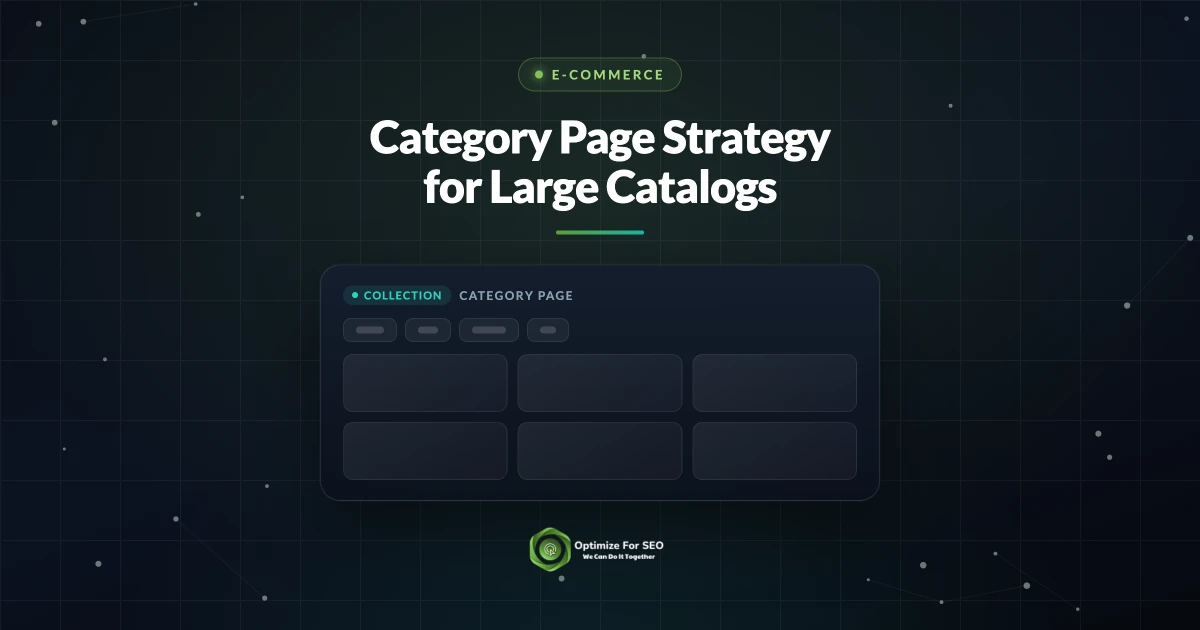
For a store with thousands of products, category pages are your biggest SEO opportunity and your biggest technical risk. They target high intent searches like "running shoes for flat feet," yet the same filters that help shoppers can spawn thousands of thin, duplicate URLs that waste crawl budget.
Treat Category Pages as Primary Landing Pages
Shoppers who search for a product type rather than a brand usually land on a category, not a single product. That makes these pages your best chance to rank for broad, valuable queries.
- Map each important search to a category, and create dedicated pages for high demand segments instead of forcing everything through filters.
- Give each category a clear, keyword-aligned title and heading that match how people actually search.
- Prioritize by demand and margin, so your effort goes to the categories that can move revenue.
Control Faceted Navigation Before It Controls You
Filters for color, size, price, and brand generate URL combinations at a huge scale. Left unmanaged, search engines crawl endless near-duplicate pages and dilute your rankings.
- Decide which filtered pages have real search demand, such as "black leather sofas," and let those be indexed.
- Block or noindex low value combinations, like arbitrary price ranges stacked on multiple filters.
- Use canonical tags to point minor variations back to the main category.
- Keep crawl budget focused by disallowing infinite parameter combinations in robots rules.
The goal is a small set of valuable, indexable pages, not one page for every possible filter click.
Add Content That Earns the Ranking
A category page that is only a grid of products gives search engines little to rank. A short block of genuinely useful content changes that.
- Write a concise intro that explains the range and helps shoppers choose, placed where it does not push products down on mobile.
- Answer buying questions specific to that category, such as sizing, materials, or compatibility.
- Keep it original, since duplicated boilerplate across categories adds no value.
Build Internal Linking That Guides Crawlers and Shoppers
On a large catalog, internal links decide what gets found and what stays buried. Link from parent categories to key subcategories, and from popular products back up to their category. Use descriptive anchor text that matches the target page. This spreads ranking signals to the pages that matter and helps shoppers move naturally through your range. A clear ecommerce SEO structure keeps deep pages within a few clicks of the homepage.
Manage Pagination and Sorting Cleanly
Long categories span many pages, and how you handle them affects indexing. Make sure paginated pages are crawlable so products on page five are still discovered, and keep sort-order variations from creating duplicate URLs. Avoid infinite scroll that hides products from crawlers with no linkable page behind it. The aim is simple: every product should sit on a stable, reachable URL.
Want a Category Structure That Scales?
Getting category strategy right on a large catalog takes planning across content, crawling, and internal links at the same time. If your collection pages are underperforming or your filters are creating chaos, we can map a structure built to rank and scale. Contact Optimize For SEO for a catalog and category audit.
Want this handled for you? Our eCommerce SEO services can help you scale rankings and revenue across your catalog.
Aashirvad Kumar
Writes about SEO, digital marketing and growth at Optimize For SEO.