You have started investing in AI search. Your content is written to be quoted, your brand is showing up in more answers, and your team is confident it is working. Then finance asks the obvious question: how do you know it is paying off? You open your analytics, look for traffic from ChatGPT or Perplexity, and the number is tiny. It does not match the wins your sales team keeps mentioning.
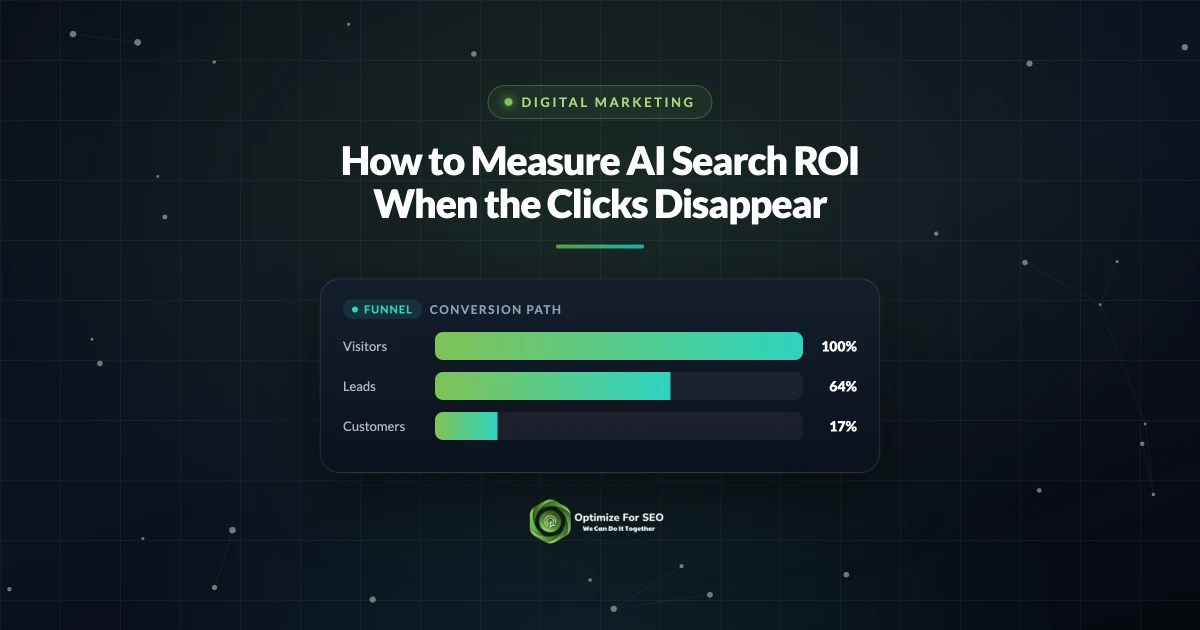
This gap is the central problem of AI search measurement. AI assistants create demand and close objections without ever sending a click, so the tools built for the click era miss most of it. The answer is not to give up on measurement. It is to measure the right things in the right layers. This guide gives you a simple, honest way to measure AI search ROI, even when the clicks disappear.
Why your analytics undercount AI traffic
Before you trust any number, understand what your analytics can and cannot see. Google Analytics now has an AI Assistant channel that groups visits from tools like ChatGPT, and it is genuinely useful. But treat that number as the floor, not the truth. Several things push the real figure much higher than what you see.
Most AI conversations end without a click at all. Someone asks a question, gets a full answer, and acts on it later. No visit, no record. On top of that, many AI apps drop the referrer before the visitor reaches your site, especially on mobile and desktop apps, so those visits land in your reports as direct traffic. People also switch devices mid research, starting on a phone and finishing on a laptop, which breaks the trail again.
The result is a large dark funnel. Real influence is happening that never shows up as a tidy line in your dashboard. So when you measure AI search ROI, start by accepting that your directly tracked number is a fraction of reality, then build outward from there.
The same discipline applies to classic SEO. Our guide Is SEO worth it? shows how to estimate the return from your own numbers before you sign a retainer.
A simple three layer way to measure AI search ROI
The cleanest approach is to sort your evidence into three layers, from what you can prove to what you can only infer. Each layer answers a different question, and together they tell the full story.
Layer 1: What you can directly attribute
This is your floor, the number you can stand on. It includes the AI Assistant traffic in your analytics plus any leads you can tag back to an AI source in your CRM.
Set up a simple AI source tag in whatever system you use to track leads, so any enquiry that arrives with a referrer from an AI tool is flagged. Then add one more thing that costs nothing and is often the most reliable signal of all: a "How did you hear about us?" field on your contact and quote forms, with an option for ChatGPT or AI search. Ask the question on sales calls too. Self reported answers fill the gap your tracking cannot.
This layer is the only one you can attach a firm dollar figure to. A small number tied to real revenue beats a big number tied to nothing. Just remember it undercounts, so never present it as the ceiling.
Layer 2: What AI search influences
This is where the real story lives, and where you build the case for the budget. Influenced signals are things AI search moves without getting direct credit.
Watch your branded search. As people meet your brand inside an AI answer, more of them type your name into Google days later. That shows up as growing branded organic traffic, and it usually converts well because the research is already done. Watch your direct traffic too, since many people copy your domain out of an answer instead of clicking a link.
Look at the shape of your sales, not just the source. When AI answers handle pricing, comparison, and objection questions during research, buyers arrive warmer and readier. Sales cycles get shorter, and win rates against competitors improve, because the hard questions were settled before the first conversation. None of these carry a neat source label, yet they move your cost per acquisition and your close rate more than a raw traffic count ever could.
Layer 3: Your leading indicators
The third layer is about the future. These are the AI visibility metrics that tell you whether you are on track long before the revenue shows up: how often AI assistants mention your brand, your citation or visibility rate in your category, and whether the sentiment of those mentions is accurate and positive.
The question this layer answers is strategic. Can your brand afford to be absent from these answers two years from now, when even more buyers start their research there? Tracking share of voice and citations today is how you protect that position. If you want the groundwork behind these signals, see where AI checks before recommending your business and our guide to agentic search for your business.
Build a one page AI search dashboard
You do not need expensive tooling to measure AI search ROI. Put these on a single page and update them monthly:
- AI Assistant traffic and any AI tagged leads (Layer 1)
- Branded organic traffic and direct traffic trend (Layer 2)
- Average sales cycle length and win rate, if you track them (Layer 2)
- AI share of voice, citation rate, and sentiment for your top topics (Layer 3)
The build is the easy part. The value comes from watching the lines together over time, because AI search is a story that only makes sense across months, not in a single snapshot.
How to read the numbers without fooling yourself
A word of caution, because it is easy to take credit you have not earned. Layers 2 and 3 are correlation, not proof. Branded search can rise for many reasons, including a campaign, a press hit, or a seasonal bump. Treat the whole thing as an experiment. Give it at least six months, keep doing the AI search work consistently, and look for the metrics to move together rather than leaning on any one number. When branded search, direct traffic, warmer leads, and rising citations all trend up at once while you are actively investing, that pattern is your evidence.
This is exactly how we frame reporting for clients at Optimize For SEO. We pair the AI search work with the older discipline of a strong site and clear content, then measure AI search ROI across all three layers so the results hold up in a boardroom. If you want that structure built for your business, our SEO services include the measurement layer, not just the visibility work. And if you are still deciding where to show up in the first place, start with our companion guide on SEO beyond your website.
Measuring AI search ROI is not about finding one perfect number. It is about proving impact honestly across what you can attribute, what you influence, and what you are building toward. Do that, and the disappearing click stops being a problem and starts being a story you can tell with confidence.
FAQ
Can I really measure AI search when there are no clicks?
Yes, but not with a single click based number. You combine directly tracked leads, influenced signals like branded search and warmer pipeline, and leading indicators like AI citations. Together they show impact even without the click.
Is the GA4 AI Assistant channel accurate?
It is useful but incomplete. Referrer loss, no-click answers, and device switching mean it undercounts real AI influence, so treat it as a floor and build the other layers around it.
What is the single easiest thing to set up first?
Add a "How did you hear about us?" field with an AI or ChatGPT option to your forms, and ask on sales calls. Self reported data is cheap and often your most reliable direct signal.
How long before the numbers mean something?
Plan for at least six months of consistent work. AI search measurement is a trend you read over time, not a snapshot you judge in week one.
How do I avoid taking credit I did not earn?
Treat influenced metrics as correlation, not proof. Watch several signals move together while you are actively investing, and rule out obvious alternative causes like a campaign or a seasonal spike.
Want this handled for you? Our SEO services agency can help you grow your organic traffic and revenue.
Aashirvad Kumar
Writes about SEO, digital marketing and growth at Optimize For SEO.