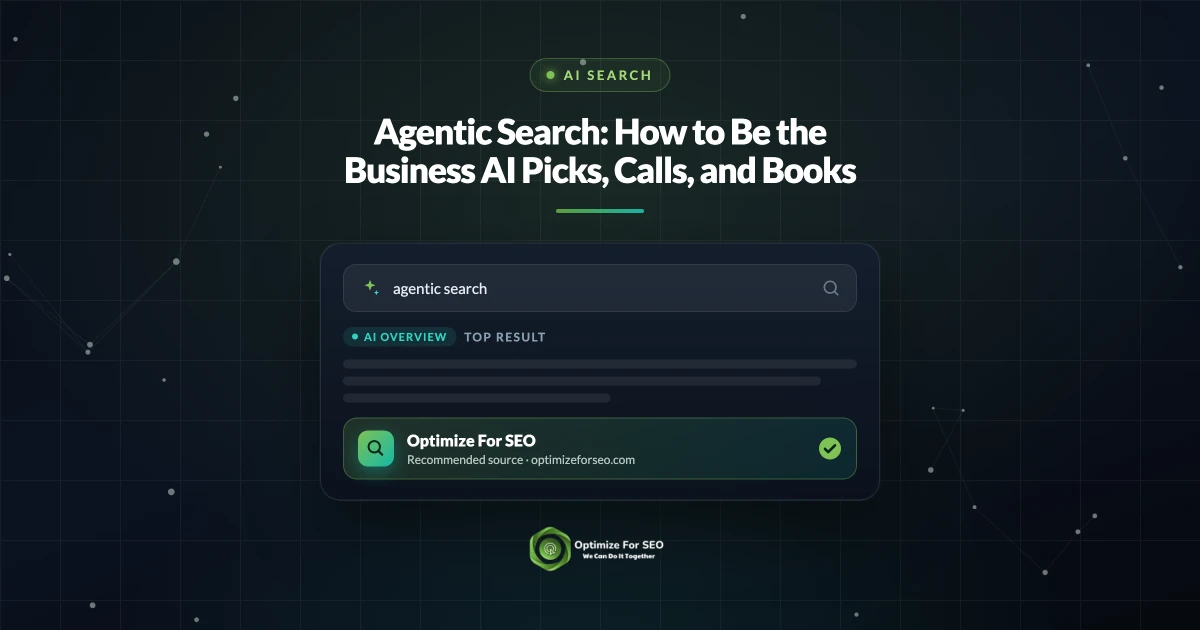
Agentic search is the shift from a search engine that hands you links to one that completes the task for you. Instead of showing ten blue links, an AI agent now reads the options, decides, and acts, calling a business, booking an appointment, or adding a product to a cart. For a business, that changes one thing profoundly: the agent picks a single option to act on, and if it does not pick you, the customer never sees you at all.
At Google I/O 2026, Google confirmed this direction. AI Mode is now the default, running on Gemini 3.5 Flash, and Google announced agents that monitor the web around the clock, book local experiences and services, and even call businesses on a user's behalf for categories like home repair, beauty, and pet care (US rollout in summer 2026). This post explains how these agents decide, and the concrete things to fix so they choose your business.
Key Takeaways
- Agentic search means an AI agent acts for the user (calls, books, buys), and it acts on one business, not a page of ten.
- Agents choose the option with the cleanest, most consistent, machine-readable data: verified profile, structured data, real-time availability, and strong reviews.
- For local services, being callable and bookable with accurate hours and a verified Google Business Profile is now a ranking factor for agents.
- For e-commerce, a clean, complete product feed with structured data is what puts you inside AI shopping and a Universal Cart.
- The winners are businesses with genuine, first-hand expertise and consistent signals; thin, templated pages lose ground.
What Is Agentic Search?
Agentic search is a search experience where an AI agent carries out multi-step tasks on the user's behalf instead of only returning results. The user states a goal ("book a dog groomer near me for Saturday"), and the agent gathers options, compares them against the request, and completes the action. Google's Information Agents, announced at I/O 2026, go further and monitor the web 24/7 for criteria a user sets, sending updates as things change. These launch in summer 2026 for Google AI Pro and Ultra subscribers.
The practical meaning for your business is that a machine, not a person, is now the first reader of your online presence. It does not scroll, admire your design, or give you the benefit of the doubt. It parses data and picks the option it can act on with confidence.
Why Agentic Search Changes the Game for Businesses
Traditional search rewarded being on page one among several visible results. Agent-driven search collapses that to a single choice. When an agent books an appointment or adds an item to a cart, it selects one provider, so the gap between first and second place becomes the gap between a customer and nothing. Google's own framing of the 2026 updates is that they reward original, first-hand, credible content and demote thin or mass-produced pages, which means the businesses agents trust are the ones that prove real expertise and keep their information consistent everywhere.
This is why answer engine optimization now matters as much as classic SEO. If you want the mechanics of being the source an assistant trusts, our guide on how to get cited by ChatGPT and Perplexity covers the citation side, and this post covers the action side: being the business the agent actually transacts with.
How Do AI Agents Choose Which Business to Call or Book?
An agent optimizes for a confident, completable action. In practice it favors the business whose signals remove doubt:
- Consistency: your name, address, phone, category, and hours must match across every source. A contradiction makes an agent hesitate and move to a cleaner option.
- Structured data: machine-readable markup (LocalBusiness, Service, Product, Offer, and opening hours) tells the agent exactly what you do, where, and when, without guessing.
- Real-time availability: accurate hours and, where possible, live booking or appointment data let the agent complete the task now rather than defer it.
- Reviews and reputation: recent, genuine reviews across the platforms your customers use signal that the action is safe.
- Reachability: for the new AI calling feature, a working, correctly listed phone number and a business that actually answers is the difference between a booked job and a skipped one.
What to Fix Now to Be Agent-Ready
Start with the signals an agent reads first. Claim and fully complete your Google Business Profile, choose the correct primary category, and keep hours current. Add LocalBusiness structured data to your site so your core facts are machine-readable, and make your booking path simple and, ideally, integrated so an agent can complete it. Then align your name, address, and phone across Maps, review sites, and directories so nothing contradicts. These are the same foundations that lift local rankings, which is why an audit from an AEO and SEO team that fixes them once pays off across both classic and agentic search.
Agentic Shopping: Getting Into the Universal Cart
Google also expanded agentic shopping at I/O 2026, including a Universal Cart that lets users buy across the web. To be eligible, your products need a clean, complete feed and correct Product and Offer structured data: accurate price, availability, GTIN or identifiers, shipping, and returns. Missing or stale attributes are the most common reason a product is skipped by an AI shopping agent. If you run a store, the same feed hygiene that powers Shopping ads also powers agentic checkout, so treat it as core infrastructure. Our e-commerce SEO service maps and fixes the product data that AI shopping relies on.
How to Measure Whether Agents Find You
You cannot improve what you never test. Run the real prompts your customers would use in AI Mode and other assistants ("best [service] near me", "book a [service] for [day]", "buy [product] under [price]") and note whether you appear, how you are described, and whether the agent could act on you. Track your branded and category mentions over time, and watch for wrong hours, prices, or descriptions the agent might be reading from a stale source. Fix the source, not just the symptom.
Do this on a schedule, not once. These features roll out gradually by market and category, so your visibility can change week to week as agents gain new abilities. Keep a short list of the exact questions a real customer would ask, run them monthly across Google AI Mode, ChatGPT, Gemini, and Perplexity, and record which competitors the agents surface and why. When an agent describes you wrongly or skips you, trace it back to the specific profile, listing, or feed that fed the mistake and correct that record. Over time this turns agent visibility from a guessing game into a measurable, repeatable checklist you can manage.
Agent-driven search rewards the same discipline that has always won in SEO, applied with more rigor: be a real, expert business, and make every signal about you consistent and machine-readable. Do that and you become the option the agent can confidently pick. If you want a full audit of how AI agents currently see your business, and where your signals contradict, talk to our team and we will map every source that matters.
Read More
- How to Rank in Google's AI Overviews
- How to Get Your Brand Cited by ChatGPT and Perplexity
- AEO vs GEO vs SEO: What's the Difference and Why It Matters
- Structuring Content for AI Answer Engines
Frequently Asked Questions
What is agentic search in simple terms?
It is search where an AI agent completes a task for you instead of just listing links. It compares options and then acts, for example by calling a business, booking an appointment, or adding a product to a cart.
How is agentic search different from AI Overviews?
AI Overviews summarize an answer on the results page. Agentic search goes a step further and takes action on the user's behalf, which means it selects a single business to transact with rather than presenting several.
How do I make my business easy for an AI agent to book?
Verify and complete your Google Business Profile, keep hours accurate, add LocalBusiness and Service structured data, offer a simple or integrated booking path, and make sure your listed phone number works and is answered.
What do e-commerce stores need for agentic shopping?
A clean, complete product feed with accurate Product and Offer structured data, including price, availability, identifiers, shipping, and returns. Stale or missing attributes are the top reason products get skipped.
Does traditional SEO still matter now that agents can act?
Yes. Consistent data, structured markup, reviews, and genuine expertise are the same foundations that lift classic rankings and that agents rely on. Agentic search raises the stakes rather than replacing the fundamentals.
When are these Google agent features available?
Google announced them at I/O 2026. AI calling and expanded agentic booking begin rolling out in the US in summer 2026, and Information Agents launch the same summer for Google AI Pro and Ultra subscribers.
Want this handled for you? Our AI SEO services can help you rank on Google and get cited by ChatGPT, Gemini, Claude and Perplexity.
Aashirvad Kumar
Writes about SEO, digital marketing and growth at Optimize For SEO.