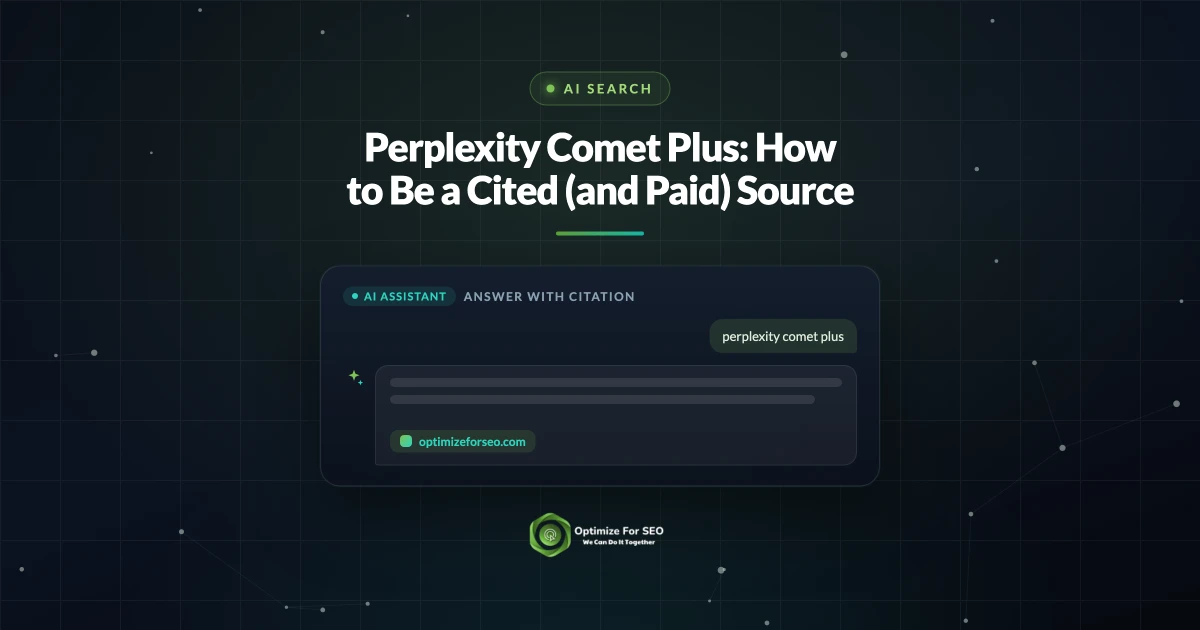
Perplexity spent 2026 rewiring the economics of AI search. The Comet browser, which launched in July 2025 gated behind a $200-a-month plan, is now free, and a subscription called Comet Plus routes the majority of its revenue back to the publishers whose work gets used. Perplexity describes Comet Plus as the first compensation model built on three kinds of internet traffic: human visits, search citations, and agent actions. For any business that publishes content, that one sentence is the whole story. Being cited is starting to pay.
This changes the calculation for anyone competing for attention inside AI answers. Perplexity is not Google, and being picked as a source follows different rules than ranking a page. This post covers what Comet Plus is, how Perplexity chooses its sources, why that differs from Google ranking, and the concrete steps to become a source it quotes and, increasingly, pays.
Key Takeaways
- The Comet browser is now free on iOS, Android, Windows, and Mac after launching in 2025 behind a $200-a-month paywall.
- Comet Plus is a $5-a-month subscription, included free with Pro and Max, that shares the majority of revenue with publishers, roughly 80% of a pool reported at $42.5 million.
- Perplexity pays partners on three signals: human visits, search citations, and agent actions, so an accurate citation now carries direct monetary value.
- Perplexity favors clear, factual, well-sourced, and fresh content it can quote, which is a different discipline from ranking a page in Google.
- Perplexity is stepping back from advertising and betting on subscriptions plus revenue sharing, which raises the stakes on becoming a trusted, quotable source.
What Comet Plus Actually Is
Comet is Perplexity's AI browser, built on Chromium with an assistant that reads pages, runs searches, and completes tasks alongside you. It launched in July 2025 as an invite-only perk gated behind Perplexity's $200-a-month Max plan. In March 2026 the company dropped the paywall and made Comet available to everyone worldwide for free, taking it from niche tool to mainstream reach.
Comet Plus is the money layer on top. It is a $5-a-month subscription, bundled at no extra cost into the $20 Pro and higher Max plans, that gives users access to premium publisher content inside Perplexity. The important part is where the revenue goes. As Search Engine Journal reported, Perplexity seeded the program with a $42.5 million pool and keeps only about 20% for compute, sending roughly 80% to publishers. It pays out across three activities: a human visiting a publisher's site through Comet, the publisher being cited in an answer, and its content being used by the assistant to complete a task. Perplexity has also been winding down advertising, telling outlets in early 2026 it would step away from ads to protect user trust. Citations, not ad impressions, are becoming the unit of value.
How Perplexity Picks and Cites Its Sources
Perplexity runs live retrieval against the web, reads a handful of candidate pages, and writes a synthesized answer with numbered citations back to the sources it leaned on. The cited pages are not always the ones that rank first in Google. They are the ones that let the model answer accurately and quickly. In practice it favors pages with clear, self-contained factual statements, strong structured data, fresh and dated content, authoritative first-party sourcing, and short quotable passages it can lift verbatim. An insight buried in a dense 300-word paragraph rarely survives summarization. This is the same craft we cover in structuring content for AI answer engines, and it is why answer engine optimization is now a distinct skill from writing for a human scanner.
Why This Is Not the Same as Ranking in Google
It is tempting to treat Perplexity like another search engine to rank in, but the mechanics diverge. Google, even now that Google AI Mode is the default experience, still returns a positional list under its AI answer, and rank drives a large share of clicks. Perplexity has no blue-link results page for most queries. There is an answer and there are citations. You are either named or invisible.
The selection signal differs too. Google weighs links, authority, and relevance across a massive index. Perplexity retrieves a small set of pages per query and rewards the one that most cleanly and verifiably answers the question. A page can sit on page two of Google and still get cited if it states the answer better, while a well-ranked page can be ignored for a vague one. Optimizing only for Google rank leaves citations on the table. Getting named across assistants is its own discipline, which we break down in how to get cited by ChatGPT and Perplexity.
The Steps to Become a Source Perplexity Cites
Turn those traits into action on your highest-value pages first:
- Lead with the answer. Put a direct answer in the first two sentences of each section, then expand. Write the sentence you would want quoted.
- Mark up your facts. Add and validate Organization, Product, FAQ, and Article schema so your claims are unambiguous.
- Date and refresh. Show published and updated dates, and revisit time-sensitive pages on a schedule.
- Cite sources and stay consistent. Link to primary data, name your authors, and make sure your site, listings, and profiles agree. A contradiction makes the model pick a cleaner competitor.
- Make content extractable. Use short paragraphs, descriptive headings, and lists so the model can pull a clean passage.
These foundations pay off across both classic and AI search, which is exactly what our answer engine optimization and SEO services are built to deliver, so your best answers get surfaced, cited, and, under Comet Plus, credited.
What Comet Plus Means for Your Business
For publishers, Comet Plus is the first serious attempt to pay for the content AI answers depend on, and the payout scales with how often you are visited, cited, and used. For most businesses, the direct revenue share is secondary. The real win is visibility: being the source Perplexity quotes puts your brand in front of a fast-growing audience that now lets an AI browse and buy on its behalf. The risk is the mirror image. If a competitor is cited and you are not, the AI recommends them and never mentions you. In a one-answer interface, the gap between cited and uncited is the gap between a customer and nothing.
How to Measure Whether Perplexity Cites You
You cannot improve what you do not track. Run the real questions your customers would ask in Perplexity and record whether you are cited, how you are described, and whether the answer is accurate. Watch for stale prices or wrong hours pulled from an outdated profile, and fix the source rather than the symptom. Do this monthly, because Perplexity's index moves quickly. Our guide on measuring your visibility in AI search turns this into a repeatable checklist.
Perplexity has made its position clear: it wants to pay for good sources and quote them by name. Be the business with the clearest, best-sourced, most quotable answer to the questions your customers ask, and you become the source the model trusts, cites, and increasingly rewards. If you want an audit of how Perplexity and other assistants see your business today, talk to our team and we will map every source that shapes your answer.
Read More
- How to Get Your Brand Cited by ChatGPT and Perplexity
- Structuring Content for AI Answer Engines
- Measuring Your Visibility in AI Search
- Google AI Mode Is Now the Default: What It Means for Your Website
Frequently Asked Questions
What is Perplexity Comet Plus?
Comet Plus is a $5-a-month Perplexity subscription, included free with the Pro and Max plans, that gives users access to premium publisher content and shares the majority of its revenue back with those publishers. Perplexity pays partners based on human visits, search citations, and agent actions.
Is the Comet browser free now?
Yes. Comet launched in July 2025 behind Perplexity's $200-a-month Max plan, and in March 2026 Perplexity dropped the paywall and made the browser free on iOS, Android, Windows, and Mac.
How much of Comet Plus revenue goes to publishers?
According to Search Engine Journal, Perplexity started Comet Plus with a $42.5 million pool and routes roughly 80% of revenue to publishers, keeping about 20% for compute. Payouts scale with each publisher's visits, citations, and agent activity.
Is getting cited by Perplexity the same as ranking in Google?
No. Google returns a ranked list where position drives clicks, while Perplexity returns a synthesized answer with a handful of citations and no traditional results page. A page can be ignored by Google's top ranks and still be cited by Perplexity if it answers the question better.
How do I get my business cited by Perplexity?
Lead each page with a direct factual answer, add and validate schema, show published and updated dates, cite primary sources, keep your facts consistent across the web, and format content in short extractable passages. Then track your questions in Perplexity monthly and fix any stale source behind a wrong answer.
Want this handled for you? Our AI SEO services can help you rank on Google and get cited by ChatGPT, Gemini, Claude and Perplexity.
Aashirvad Kumar
Writes about SEO, digital marketing and growth at Optimize For SEO.