Google's August 2026 spam update finished rolling out on August 21 after two days and sixteen hours, and it hit harder than recent spam updates. Google describes a spam update as an improvement to its automated spam-detection systems, not a change to how it weighs overall quality, yet the fallout looked closer to a major core update. According to Search Engine Land, top-10 URLs were about 82% more likely to fall past position 100 for their keyword during the update than in a comparable July window.
If your traffic dropped in that window, the instinct is to panic or blame Google, and neither helps. Spam updates are narrow and rule-based: they target specific manipulative behaviors Google spells out in public policy, and recovery follows a defined path. This post covers how spam updates and SpamBrain work, what the policies forbid, how to spot a hit, and a recovery checklist you can run this week.
Key Takeaways
- The August 18 to 21 update hit harder than recent ones, with an 82% jump in top-10 URLs falling out of the top 100, per Search Engine Land.
- Spam updates refine SpamBrain, Google's AI spam-detection system. They demote policy violations, not honest-but-thin content, so the fix differs from a core update.
- The policies most in focus are scaled content abuse, expired-domain abuse, and site-reputation abuse, also known as parasite SEO.
- Diagnose before you act: confirm the drop aligns with the update dates, isolate which pages fell, and rule out core-update or technical causes.
- Recovery is possible but slow. Remove the violating behavior, and Google re-assesses over months, not days.
How Spam Updates and SpamBrain Actually Work
A spam update is not the same as a core update, and treating them alike is the first mistake. A core update re-weighs how Google assesses overall quality across the index, which is why an honest site can move up or down after one. A spam update instead tunes SpamBrain, Google's AI-based spam-prevention system, so it catches violations of the published spam policies more accurately.
That distinction matters for recovery. Google's documentation is explicit that a site hit by a spam update can recover once it comes back into compliance, and that its systems re-confirm this over months as they re-crawl. One hard exception: when a link spam update neutralizes manipulative links, the ranking value they once passed is gone for good and cannot be won back by disavowing them.
What Google's Spam Policies Actually Target
Spam updates enforce the rules in Google's spam policies documentation, and three categories have driven most of the recent damage.
- Scaled content abuse. Producing many pages mainly to manipulate rankings, with little value to the reader. It does not matter whether they come from humans, AI, or a mix; what matters is intent and value. Template-spun pages across thousands of keyword variants, lightly reworded scrapes, and mass-generated answers all qualify.
- Expired-domain abuse. Buying a lapsed domain to trade on its residual authority rather than serve the audience it built. Google's examples are stark: casino content on a former school domain, or affiliate products on an old nonprofit site. The backlinks are inherited; the relevance is faked.
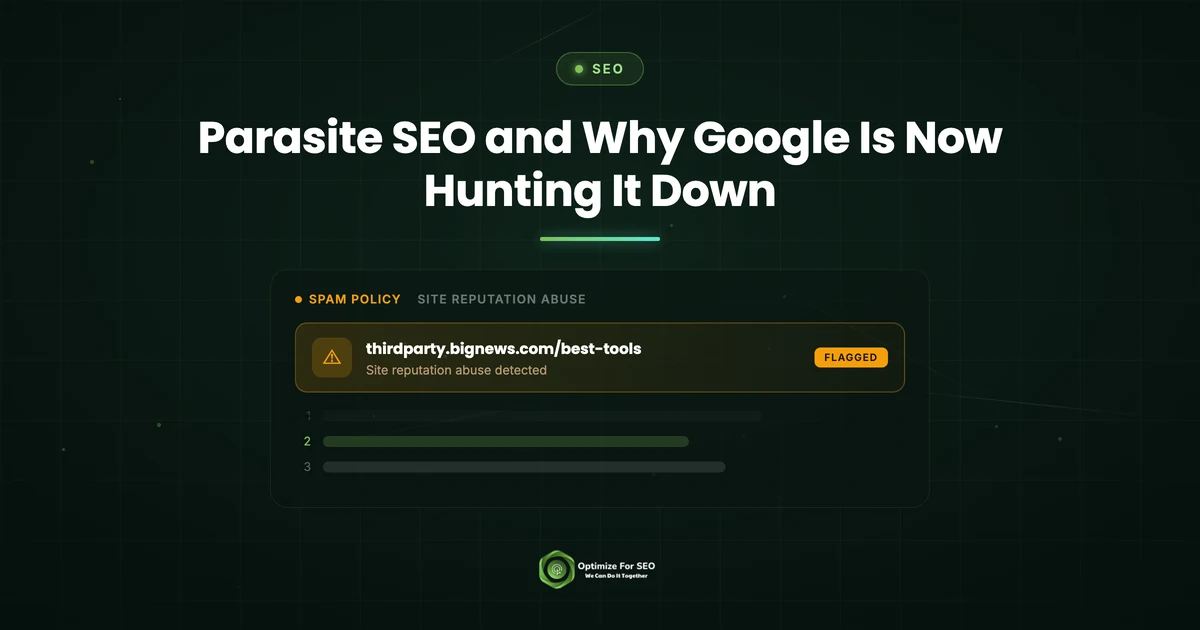
- Site-reputation abuse, or parasite SEO. Publishing third-party content on a strong host mainly to borrow its ranking signals, such as coupon or "best of" pages bolted onto a trusted news domain. Google now treats this by region: outside the EEA the pages can face manual action, while inside the EEA they are ranked on their own merits.
None of this targets an honest site with useful pages, even if its rankings wobbled while the index resettled.
How to Tell If the August Update Hit You
Before rewriting anything, confirm you were caught by this update and not a different problem. Work through three checks in order.
- Match the dates. In Search Console, look for a sharp, sustained drop that begins between August 18 and 21. A decline that started earlier likely traces to the spring core updates; one that began later points to a technical regression.
- Isolate and map the pattern. A site-wide collapse suggests a domain-level signal; a drop confined to one directory points to a policy problem there. Thin, near-identical AI pages read as scaled content abuse, unrelated third-party articles as site-reputation abuse, and an acquired domain that fell all at once as expired-domain abuse.
- Rule out non-spam causes. Confirm the pages still return 200, are indexable, and did not pick up an accidental noindex on a recent deploy. A pass against a full technical SEO audit checklist for growing sites separates a penalty from a crawl bug that coincided with the update.
Your Spam-Update Self-Audit Checklist
With the timing confirmed and the section isolated, run this audit to find the specific violation.
- Export the fallen URLs. Compare clicks and average position before and after August 18, then sort by the biggest losers so you audit the pages that actually moved.
- Audit content at scale. For each affected template, ask whether the page would exist if search did not. A keyword-swapped clone or an unedited AI draft is a scaled-content risk. Keep pages with first-hand experience, original data, or a genuine answer, and prune the rest.
- Review acquired domains. If you bought or merged a domain, check that its old backlink profile and topic match your current business. Inherited authority on an unrelated subject is a liability.
- Inventory hosted content. List every section where outside parties publish on your domain, coupons, sponsored posts, forums, user submissions, and confirm each earns its place rather than riding your reputation.
- Sweep for the classics. Check for cloaking, sneaky redirects, keyword stuffing, hidden text, and doorway pages, which older sites accumulate without anyone deciding to cheat.
The Recovery Path and How to Rebuild Trust
Recovery is not a tweak; it is removing the behavior Google's systems flagged and then earning back trust. For scaled content, consolidate thin pages into fewer strong ones and rebuild the survivors around real expertise. For site-reputation abuse, remove or noindex the parasitic section outright. For a misfired expired domain, either make it relevant to its history or migrate its value into your main brand. Google then re-evaluates over months, so resist the urge to change course every week.
Use the recovery window to build the signals spam updates reward. Concentrate depth on the topics you truly own by developing topical authority with content clusters, and route equity to your best pages with a deliberate internal linking strategy for faster indexing. If you would rather have specialists diagnose the exact policy that hit you and run the cleanup, our SEO services agency team does this work every day, across classic and AI search.
The August 2026 spam update was unusually sharp, but it did not change the rules; it enforced them. Sites that publish honest, useful pages came through it; those that leaned on scale, borrowed domains, or borrowed reputations did not. Fix the cause rather than the symptom, and give SpamBrain time to see the change. For a full audit of what dropped and why, talk to our team and we will map every page and policy that matters.
Read More
- The Technical SEO Audit Checklist for Growing Sites
- Topical Authority: Building Content Clusters That Actually Rank
- Internal Linking Strategy for Faster Indexing
- Google AI Mode Is Now the Default: What It Means for Your Website
Frequently Asked Questions
What is a Google spam update?
A spam update is an improvement to Google's automated spam-detection systems, primarily SpamBrain, its AI-based spam-prevention system. It targets pages that violate Google's published spam policies, such as scaled content abuse or site-reputation abuse, rather than re-weighing overall quality the way a core update does.
How is a spam update different from a core update?
A core update changes how Google assesses quality across its whole index, so honest sites can rise or fall. A spam update enforces specific policy rules and is meant to demote only the sites that break them. The diagnosis and fix differ, so confirm which type caused your drop before acting.
How do I know if the August 2026 spam update hit my site?
Check Search Console for a sharp, sustained drop that begins between August 18 and 21, 2026. Isolate which URLs and queries fell, match the pattern to a spam policy, and rule out technical causes like an accidental noindex or a failed migration. A decline outside that window usually points elsewhere.
Does using AI to write content trigger a spam penalty?
Not by itself. Google's scaled content abuse policy targets pages produced mainly to manipulate rankings with little value to readers, whether written by humans, by AI, or by a combination. AI-assisted content with genuine expertise, original insight, and a real answer is not what the policy is aimed at.
How long does it take to recover from a spam update?
Recovery takes months, not days. Once you remove the violating behavior, Google's systems must re-crawl and re-assess your site before they confirm it follows policy again. One exception applies to link spam: the ranking value manipulative links once passed cannot be regained, even after you remove them.
Want this handled for you? Our SEO services agency can help you grow your organic traffic and revenue.
Aashirvad Kumar
Writes about SEO, digital marketing and growth at Optimize For SEO.