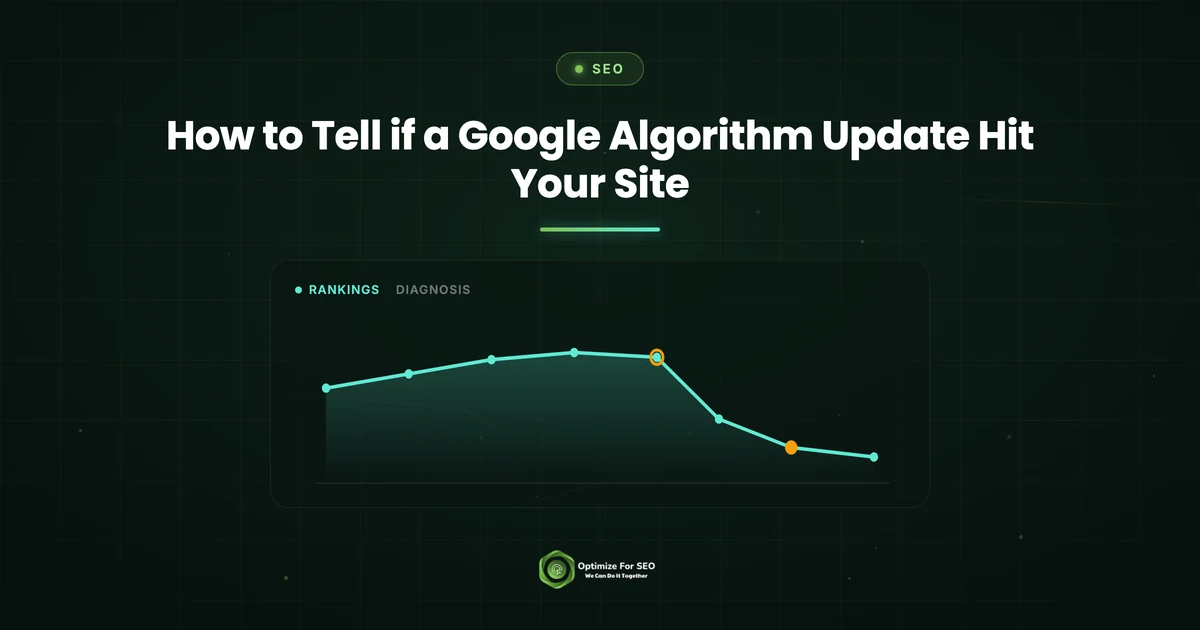
Rankings drop, traffic follows, and within an hour someone is rewriting pages, pulling links, and posting in a forum asking which update just hit. That reaction is the single most expensive mistake in SEO, because most of the time the thing people are reacting to is not what they think it is. Before you change a single thing, you need to know what actually happened. A wrong diagnosis leads to a wrong fix, and a wrong fix on a healthy site can turn a dip into real damage.
Here is the 72-hour diagnosis we run before touching anything. It works through the possibilities in order, from most common and least dramatic to the actual algorithm update people jump to first.
Step 1: Confirm the drop is real
Start by ruling out the boring explanations, because they are the most common. Open Search Console and compare the drop period against the same window earlier, and against the same period last year.
- Is this a true decline, or normal seasonality for your business?
- Did analytics or tag tracking break, so the traffic is fine but the reporting is not?
- Is the drop sitewide, or isolated to a few pages or one query cluster?
That last question matters most. A genuine algorithm update usually moves a broad set of pages at once. A drop confined to a handful of URLs points at something specific to those pages, not a sitewide event. Get the shape of the drop clear before you name a cause.
Step 2: Check Whether a Google Algorithm Update Even Lines Up
Now check the calendar, because a ranking change only counts as update-related if its timing matches a real one. Google confirms its major updates publicly, so you can line your drop date against the record. In 2026 the confirmed pattern ran roughly like this:
- core updates in March and May,
- then spam updates in August and September, with the September spam update finishing its rollout on October 8.
There was a noticeable spike in ranking volatility around mid-October as well, though not every volatile week is a named update.
If your drop lands squarely inside a confirmed rollout window, a Google algorithm update is a real suspect. If it does not line up with anything Google announced, be skeptical. Google adjusts its systems constantly without naming or announcing most of it, so movement outside a named update is normal and usually not worth a dramatic response. Do not invent an update to explain a drop that has a simpler cause.
Step 3: Rule out a manual action and a technical fault
Two things look exactly like an algorithm hit and are not. The first is a manual action, where a human reviewer at Google penalizes your site for a guideline violation. This one is easy to check and people forget to: open the Manual Actions report in Search Console. If there is a notice there, that is your answer, and the fix is specific to that notice, not a general recovery.
The second is a technical regression, and it is the most common real cause we find:
- A deploy that added a stray noindex tag,
- a robots.txt rule that blocked a section,
- a canonical pointing the wrong way,
- a migration that broke redirects,
- a spike in server errors, or
- a page that quietly started returning 404.
These cause sharp, update-shaped drops and have nothing to do with any algorithm. Work through our technical SEO audit checklist before you accept the update theory, because a technical fault is both the most likely explanation and the fastest to fix.
Step 4: Make sure it is a ranking loss, not zero-click
There is one more impostor, and it is increasingly the real story. Your rankings may be completely stable while your clicks fall off a cliff, because an AI Overview or an assistant is now answering the query and the user never clicks through. That is not an update and not a penalty. It is the search result changing shape. Check whether your average position held while clicks dropped, which is the signature of zero-click, and if so, the response is entirely different. We walk through it in the zero-click triage plan. Diagnosing this correctly saves you from trying to recover rankings that never actually fell.
Also Read :- surviving Google core updates
Step 5: If it is an update, work out which kind
Only once you have ruled out noise, timing, manual actions, technical faults, and zero-click should you treat this as a genuine Google algorithm update. Then the type tells you the fix.
- A core update is about overall quality, relevance, and experience, expertise, authoritativeness, and trust, so recovery is a content and credibility project, which is the subject of surviving Google core updates.
- A spam update targets specific guideline violations, so recovery means finding and removing whatever tripped it, which we cover in auditing your site after a spam update and recovering from a Google spam update.
Naming the type correctly is what points you at the right playbook instead of a generic one.
What not to do in the first 72 hours
While an update is still rolling out, the rankings are a moving target, and reacting to a mid-rollout position is how people make things worse.
- Do not mass-edit or rewrite the site in a panic.
- Do not disavow links reflexively.
- Do not delete pages because they lost traffic this week.
- Do not chase a single forum thread's theory as if it were confirmed.
Wait for the rollout to finish and for rankings to settle, keep measuring, and gather evidence. Patience in these three days is not passivity, it is the thing that protects you from a bad fix.
Then, and only then, fix the right thing
A correct diagnosis makes the recovery obvious.
- Technical fault, fix the technical fault.
- Manual action, resolve the specific notice and request a review.
- Zero-click, change your strategy and measurement rather than your rankings, tracking outcomes the way we describe in measuring your visibility in AI search.
- A genuine core or spam update, follow the matching recovery path and give it time.
The whole point of the 72-hour diagnosis is that you spend your effort on the real cause instead of the first one you guessed.
If your rankings dropped and you want certainty about why before you spend a month fixing the wrong thing, that diagnosis is part of what we do in our SEO services, and a free audit will tell you quickly which of these causes is actually yours.
Frequently Asked Questions
How do I know if a Google algorithm update caused my ranking drop?
Match your drop date against Google's confirmed update windows. If it lands inside an announced core or spam update rollout and the decline is broad across many pages, an algorithm update is a real suspect. If the timing matches nothing Google announced, the cause is usually something else, since Google also makes constant unannounced adjustments.
What is the difference between a core update and a spam update?
A core update reassesses overall quality, relevance, and E-E-A-T, so recovery is a content and credibility effort. A spam update targets specific guideline violations, so recovery means finding and removing whatever broke the guidelines. Identifying the type correctly points you at the right recovery playbook rather than a generic one.
My rankings are stable but traffic dropped. Was it an update?
Probably not. Stable average position with falling clicks is the signature of zero-click search, where an AI Overview or assistant answers the query and the user does not click through. That is the result changing shape, not a penalty or an update, and it calls for a strategy and measurement change rather than a ranking recovery.
Should I change my site immediately after a ranking drop?
No. While an update is still rolling out, rankings are unstable, and reacting to a mid-rollout position often makes things worse. Diagnose the real cause first, rule out technical faults and manual actions, wait for the rollout to settle, and only then apply the fix that matches the actual cause.
How do I check for a manual action from Google?
Open the Manual Actions report in Google Search Console. If a human reviewer has penalized your site, the notice appears there with the reason. A manual action needs a specific fix and a reconsideration request, which is different from recovering from an algorithmic update, so always check this report before assuming an update caused the drop.
Want this handled for you? Our SEO services agency can help you grow your organic traffic and revenue.
Aashirvad Kumar
Writes about SEO, digital marketing and growth at Optimize For SEO.