You search your most important keyword and the top result is not a competitor. It is a "best tools for" article on a giant news or magazine site that has nothing to do with your industry, written by someone who has never used any of the products, with affiliate links stuffed in. You have a better page, more relevant and more expert, and it sits below a publication that borrowed its way to the top.
That is parasite SEO, and if it has been quietly beating you, there is good news: Google is now actively hunting it down. Here is what it is, why it worked for so long, what changed, and what to do instead.
What parasite SEO actually is
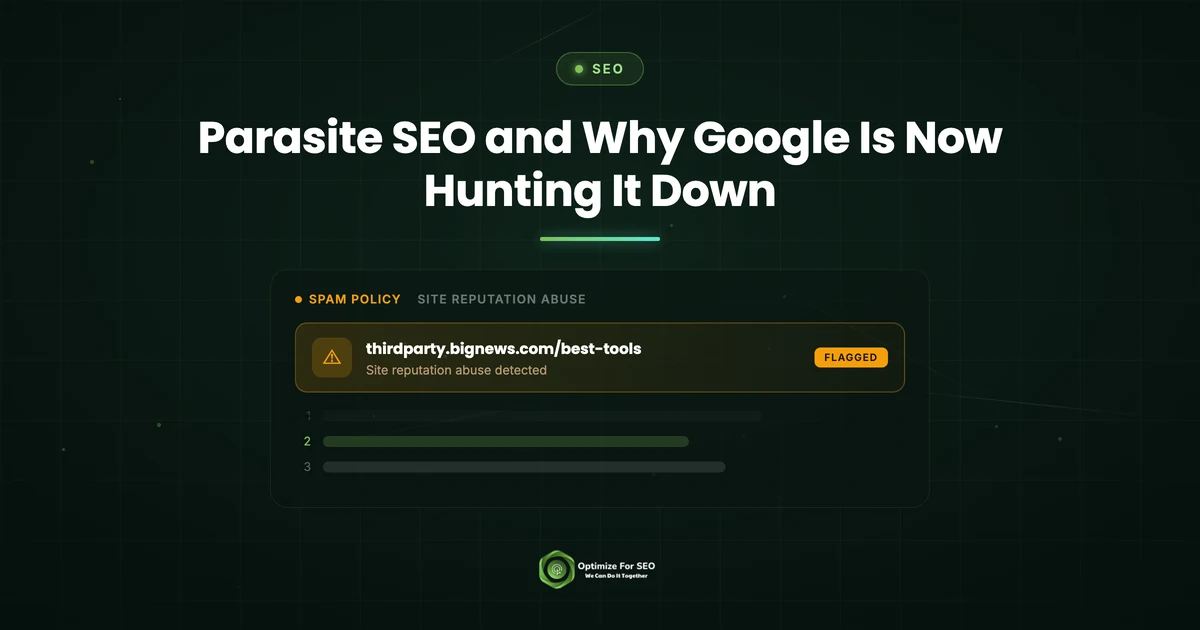
Parasite SEO is publishing content on someone else's high-authority domain to borrow that domain's ranking power, instead of earning rankings on your own site. The content usually has nothing to do with what the host is known for. Google now has a formal name for the abusive version: site reputation abuse.
In practice it shows up as:
- Coupon and deals subdomains bolted onto major media sites.
- "Best of" roundups on publications with no real expertise in the category.
- Sponsored sections that exist only to rank, often produced by a third party who paid for the placement.
The host gets paid. The third party gets rankings. The searcher gets a worse result, which is exactly why Google decided to act.
Why it worked, and why it keeps outranking you
It worked because authority in Google's systems has long attached to the domain as well as the page. A brand-new article on a hugely trusted site could outrank a genuinely better page on a smaller site, simply because the host carried so much weight.
That is the whole mechanism. The parasite page is not better than yours. It is standing on taller shoulders. For years that was enough, and it is why you can lose to a page that is obviously thinner and less relevant than your own.
Picture it concretely. A single article titled "best project management tools" appears on a celebrity gossip domain with millions of trusted links. It was published yesterday by a freelancer paid per word, and it still lands above the software companies that actually built the tools. Nothing about the page earned that spot except the domain it sits on. Now multiply that across coupons, casinos, supplements, loans, and software, and you have a whole economy of rented rankings sitting on top of results that used to belong to real businesses.
What changed: Google's crackdown
In March 2024 Google announced a site reputation abuse policy as part of a broader move against scaled and manipulative content, and it has enforced it since with both manual actions and algorithmic signals. Major publishers running these rented sections have been hit, with the offending content dropping out of results.
Two things make this different from a normal grey-area tactic:
- It is a named violation. The policy applies whether the host or a third party produced the content, as long as the point is to exploit the host's reputation.
- Enforcement keeps widening. Detection is getting better, not worse, so the payback window keeps shrinking.
Anyone building on it is building on a tactic with a public expiry date, the same pattern we describe for every short-lived hack in surviving Google core updates.
Should you try it? Almost certainly not
Here is the honest risk calculation if you are tempted to buy a placement:
- You own nothing. Even when it ranks, you are renting a position on someone else's domain, with no control.
- It can vanish overnight. When Google acts, the content disappears and you are left with no asset and no authority of your own, just a bill.
- You inherit the host's risk. If the host gets penalized, you go down with it.
- The window is closing. The payback period keeps shrinking while the risk grows.
For any business that intends to exist in a few years, it is a bad trade: spending money to rank temporarily on a foundation you do not own, in a way Google has publicly committed to stopping. Shortcuts like this age into liabilities, which is worth taking seriously across your whole strategy, as we cover in how to tell if a Google update hit your site when the bill comes due.
Also Read :- auditing your site after a Google spam update
What to do instead, so the ranking is actually yours
The durable answer is unglamorous, and it compounds: build your own authority so you are the taller shoulders. Spend the same budget here instead:
- Genuine topical depth on your own domain, a cluster of connected, actually useful pages, covered in building topical authority with content clusters.
- Real expertise and experience signals, so your pages demonstrate first-hand knowledge the rented pages never have.
- Earned mentions and reviews from relevant, credible sources, the honest version of borrowing reputation, covered in using reviews to boost trust and SEO.
It is slower than renting a spot on a news site. It is also still there next year.
If a parasite page is outranking you right now
If you are on the losing end of this, you have real options. Work through them in order:
- Compete where it is weakest. Parasite pages rarely have genuine relevance, depth, or first-hand expertise. Out-do them on exactly that.
- Report it. You can report site reputation abuse to Google through its spam report tools, and with active enforcement these pages are increasingly on borrowed time.
- Build to take the spot. Keep building durable authority so that when the parasite page is removed, you are the obvious result ready to replace it.
The crackdown is, for once, working in favor of the businesses doing it properly. If you want to win these rankings the way that lasts, by becoming the authority rather than renting one, that is exactly the work in our SEO services, and a free audit will show you where you are losing to parasite content and how to take those positions for good.
Frequently Asked Questions
What is parasite SEO?
Parasite SEO is publishing content on a high-authority domain you do not own to borrow its ranking power, instead of earning rankings on your own site. The content is often unrelated to the host and placed there, frequently for payment, purely to rank. Google now calls the abusive version site reputation abuse and treats it as a policy violation.
Is parasite SEO against Google's guidelines?
Yes. In March 2024 Google introduced a site reputation abuse policy and has enforced it with manual actions and algorithmic signals since. It applies whether the host or a third party created the content, as long as the goal is to exploit the host's reputation for rankings it did not earn. Major publishers have already been penalized.
Why does an unrelated site outrank my relevant page?
Because ranking authority has historically attached to the whole domain, not just the page, so a thin article on a very trusted site could outrank a better page on a smaller one. The parasite page is not better than yours, it is standing on the host's reputation. Google's crackdown is specifically targeting this mismatch.
Should my business use parasite SEO to rank faster?
Almost certainly not. Even when it works, you rent a position you do not control, build no authority of your own, and risk losing everything the moment Google enforces, which it increasingly does. You can also be dragged down if the host is penalized. For any lasting business it is a poor trade against building your own authority.
What can I do if parasite content is outranking me?
Compete on genuine relevance, depth, and first-hand expertise, which rented pages lack, report site reputation abuse through Google's spam report tools, and keep building durable authority on your own domain. With active enforcement, many parasite pages are on borrowed time, so being the strongest legitimate result positions you to take the spot when they fall.
Want this handled for you? Our SEO services agency can help you grow your organic traffic and revenue.
Aashirvad Kumar
Writes about SEO, digital marketing and growth at Optimize For SEO.