ecommerce case study
E-commerce Case Study: $123K Revenue in 30 Days with SEO, Paid Ads and CRO
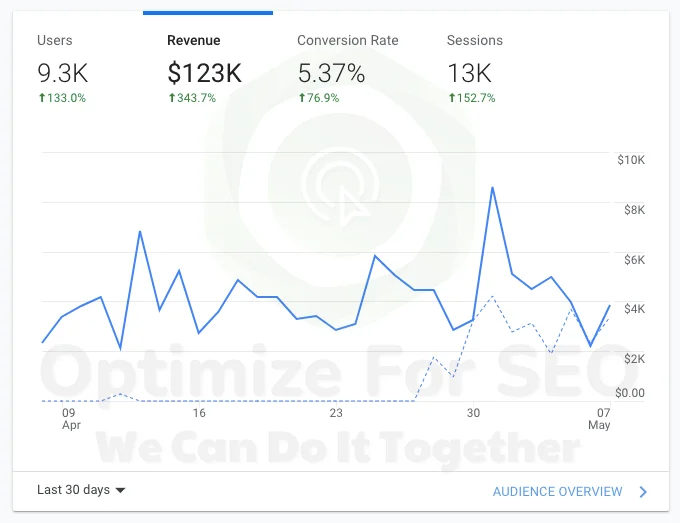
This case study covers a 30-day sprint for an ambitious e-commerce brand, which is not named here. Its store already had traffic, but too many shoppers left product pages without buying, and its ad spend was not turning into profitable orders.
The brief was simple but demanding: turn the online store into a predictable, high-converting source of revenue, and do it fast. Optimize For SEO ran SEO, paid advertising and conversion rate optimization as one plan with one revenue goal. In 30 days the store generated $123,000 in revenue, revenue grew by 300%, and the conversion rate reached 5.37%.
About the project
The client sells through its own online store. What it lacked was a reliable way to turn visits into profitable orders.
- Client: an e-commerce brand, kept anonymous in this case study.
- Starting point: traffic was coming in, but sales did not match it.
- Engagement: a single 30-day sprint.
- Channels: SEO, paid advertising and conversion rate optimization, run together.
The challenge
Like many growing stores, the brand was leaving money on the table. The issue was not getting visitors. It was what happened after they arrived, and how much it cost to bring them in.
- Product pages that did not convert. Shoppers landed on product pages and left without buying.
- Ads that did not pay back. Ad spend was not translating into profitable orders.
- Limited organic reach. The store had little visibility for buyer-ready keywords, the searches most likely to end in an order.
- The wrong scoreboard. The brand needed a partner who would connect traffic, shopping experience and revenue, not chase vanity metrics.
What we did
- Technical cleanupA technical cleanup of the store, so search engines could crawl and understand its product and category pages.
- Product and category pagesProduct and category pages were optimized around the words shoppers use when they are ready to buy.
- High-intent keywordsThe SEO work targeted commercial, high-intent keywords, so ready-to-buy shoppers could find the store organically and not only through ads.
- Paid campaigns around best-sellersAd campaigns were tightly structured around the store's best-selling products and audience intent, so budget went first to what already sold.
- Optimized for return, not clicksCampaigns were optimized toward return on ad spend rather than clicks alone, so every change was judged by the revenue it brought in.
- Landing pages and checkoutLanding page and checkout refinements, clearer calls to action and visible trust signals lifted the conversion rate to 5.37%.
Results over the 30-day sprint
The results
| Metric | Result |
|---|---|
| Revenue generated | $123K |
| Time frame | 30 days |
| Revenue growth | +300% |
| Conversion rate | 5.37% |
A 5.37% conversion rate is well above typical e-commerce benchmarks. With search, paid and on-site experience aimed at a single revenue goal, the brand scaled quickly and profitably in one month.
Why conversion rate was the main lever
When a store already has traffic, the quickest gains usually come from the visitors it already has. Raising the share of visits that end in an order makes every channel worth more at once: each organic visit and each paid click becomes more likely to pay back.
That is why the three channels ran as one plan. SEO and paid ads were aimed at shoppers with buying intent, and conversion work made sure the pages they landed on did their job.
How a 30-day sprint is usually paced
A month is long enough to fix, launch and adjust, but too short to wait for slow results. So the fastest wins usually come first, and the longer-term work starts early.
- Find the leaks first. Look at where visitors drop off between landing page, product page and checkout, and where ad spend goes without bringing back orders.
- Fix what every visitor sees. Clearer calls to action, trust signals and a smoother checkout help every visit, whichever channel it came from.
- Point paid budget at what sells. Build campaigns around best-sellers and buying audiences, and judge them by return on ad spend.
- Start SEO on the money pages. Technical fixes and product and category page work begin inside the sprint and tend to keep paying back after it ends.
When this approach fits your store
- You get steady traffic, but many shoppers leave product pages without adding anything to the cart.
- Your ads bring clicks, but you cannot see a clear return on ad spend.
- Organic search sends visitors for broad terms, but not for the searches that end in a sale.
- You want a measurable result within a month, plus work that keeps paying back afterwards.
If most of these sound familiar, running all three channels together is usually faster than fixing them one at a time.
Want results like these?
If your store has traffic but not the sales to match, see our e-commerce SEO services and Shopify SEO agency work, or talk to Optimize For SEO about a tailored growth plan for your store.
Results: Optimize For SEO project records for this 30-day engagement. The brand is not named in this case study.